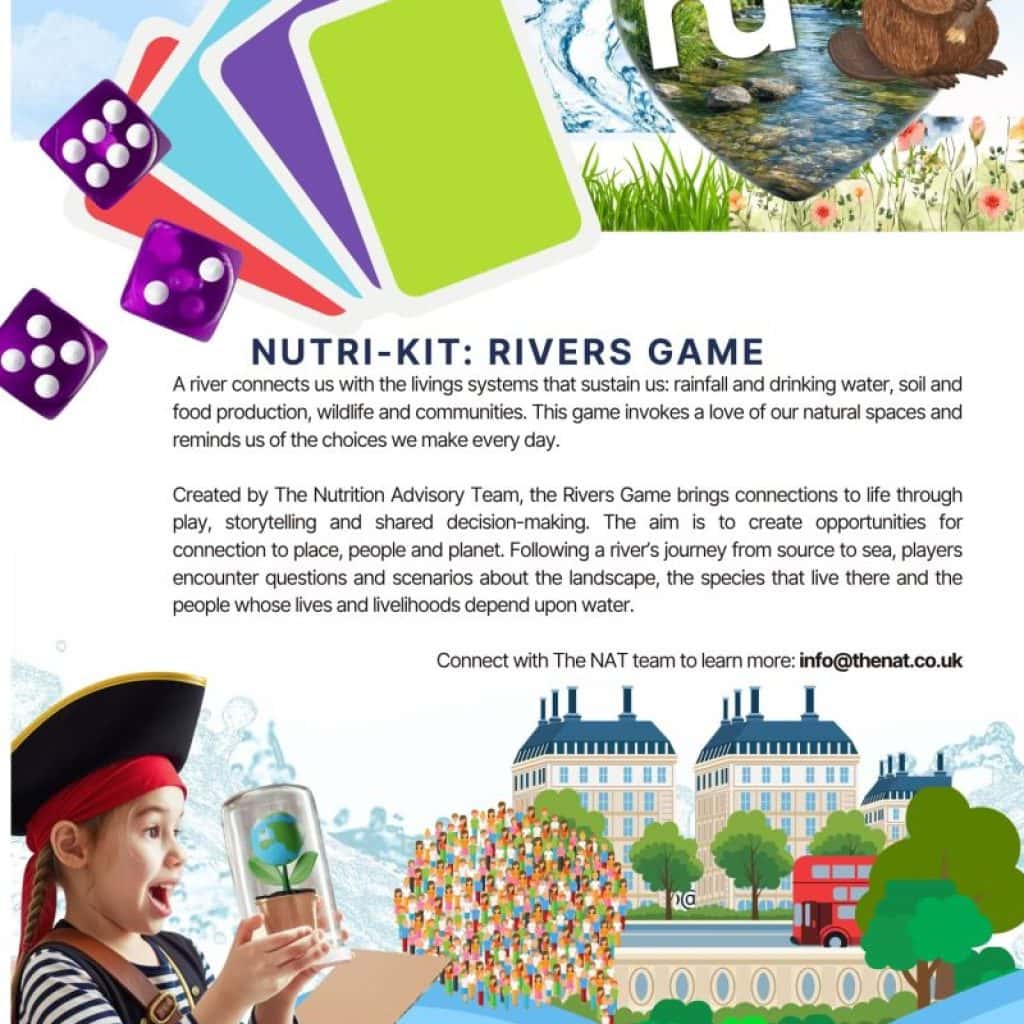


We’ve created a rivers game, and it’s going down a storm. Quite literally!
It started with our Nutri-Kit® Hydration Module and a question you can ask with a glass of water in your hand. How far back can you trace the water?
Start at the school tap. Follow the pipes back to the treatment works. Where did the water come from? A reservoir? A river? An aquifer beneath our feet? In Dorset, tracing groundwater can lead us to the same chalk that feeds springs, streams, and watercress farms. Follow the tributaries and you begin to see how much of the landscape is connected to the river.
At The Nutrition Advisory Team we love a question or two.
Where does rain go when it lands on a dry field?
What happens when a river has room to spread onto its floodplain?
What changes downstream when a storm overflow discharges?
On a hot summers day where can fish find cooler water?
How do we decide how much water to take when households, farms and wildlife all depend on it?
Those questions feel close to home after the heat of summer 2025 and the Dorset heathland fires of 2026. The National Emergency Briefing considers changing weather extremes at a UK scale. Dorset’s climate adaptation work brings that conversation home through decisions about water supplies and flood resilience. Our Local Visitor Economy Partnership has a stake in it too.
If nature and outdoor experiences are part of what draws people to Dorset all year-round, caring for those places is part of sustaining the visitor economy.
I work in food systems thinking. Nutrition studies took me back to soil and water. Follow the water. Follow the food. A catchment helps us to grow food, and the way we grow food shapes the river. Soil washed off a field is soil a farmer needs for the next crop. If it settles between the stones where trout lay their eggs, it can change the conditions those eggs need to survive. The river has a food web of its own, too. A young mayfly can feed a trout, and a trout can feed an otter. Those relationships also give us a way to ask where the fish on our plates come from and what those food systems depend on.
We’ve been busy meeting people to trial the game and expand its use for community conversations.
Last week I met with Edd Moore to discuss collaborating on a bespoke activity pack to sit alongside the game. We’re exploring how Climate Ambassadors could use the pack in their work with schools and encourage greater youth citizen science activities.
Our rivers game connect the dots between the water we drink, the food we eat and the rivers that sustain us, and it’s learning made fun. Let’s see where the river takes us.